
If you ask Argentines what they believe or which church they belong to, you get one picture. If you ask what they actually do, you get a very different one. That is the premise of the National Survey on Lived Religion (ENReVi 2026), whose first report was released in September 2026 by sociologists Hugo H. Rabbia (Universidad Católica de Córdoba / CONICET) and Gustavo Morello, SJ (Boston College).
Instead of starting from affiliation and belief, the study looks at the “religion actually lived” by people: what they do “when they do religion”, whether or not they identify with a faith, and whether or not they are believers. The team surveyed 2,414 adults across all 24 Argentine jurisdictions and asked about 19 different practices, from prayer and Mass to meditation, tarot, and AI chatbots.
Key findings at a glance
- 95.2% did at least one religious or spiritual practice in the past year.
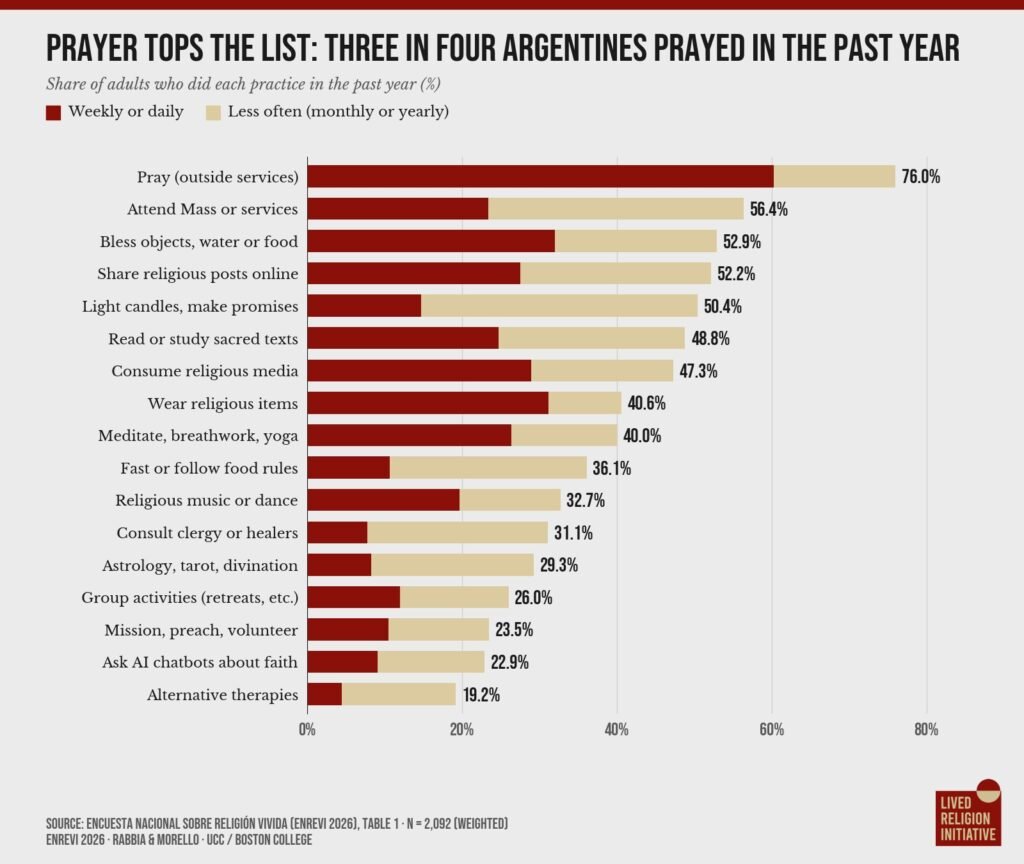
- 76% pray, and 60.3% pray weekly or daily.
- 30.4% keep a home altar or place of devotion.
- 22.9% asked an AI chatbot about religion or spirituality.
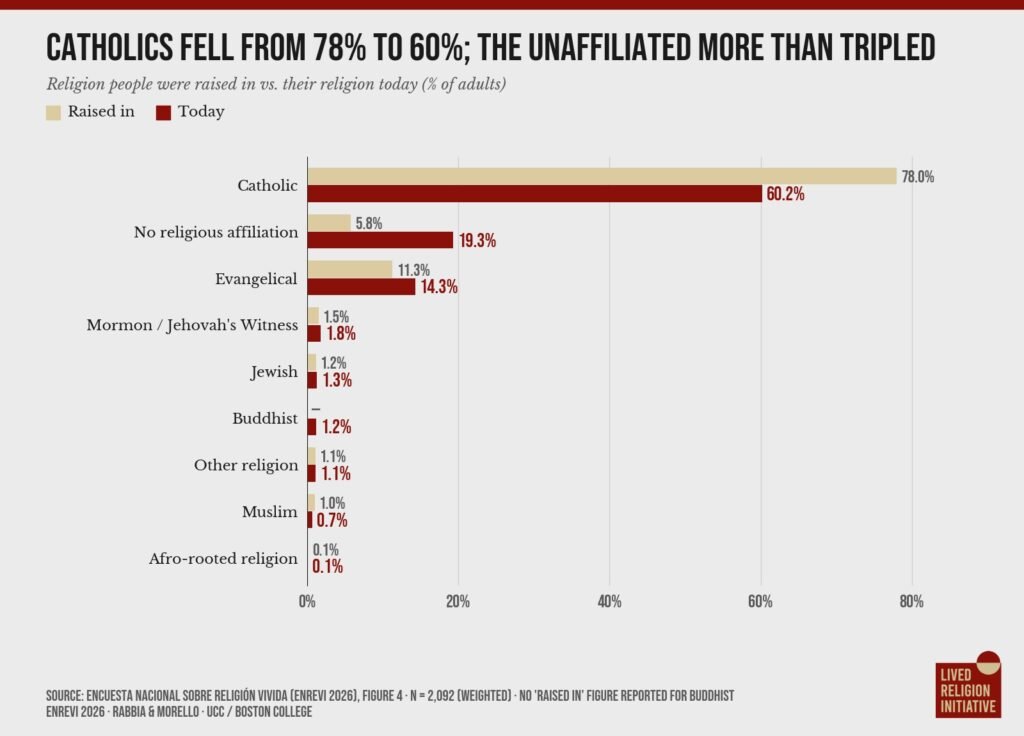
- Catholics fell from 78% (raised) to 60.2% (today); the unaffiliated rose from 5.8% to 19.3%.
- 16.5% (over 5 million adults) plan to see Pope Leo XIV during his visit.
Religion is everywhere
95.2% of Argentine adults did at least one religious or spiritual practice in the past year. Only 4.8% did none. On average, people reported 6 of the 19 practices the survey asked about, a wide and varied repertoire.
Prayer is by far the most common practice: 76% pray, and 60.3% do so at least weekly, often daily. Attending Mass or religious services looks very different. Its intensity ranges from the 21.7% who go only on special occasions (about once a year) to the 23.4% who attend weekly.
Some practices split people in two. Consuming religious media, wearing religious items and meditating are things most people never do. But those who do them tend to do them weekly or daily.
The home and the body as sacred spaces
The home has become a key place of practice. 30.4% of Argentines keep a home altar, a mezuzah, a gohonzon or some other place of devotion. People who pray and people who meditate mostly do it in their own homes.
It is also a solitary practice:
- Prayer: 70% pray alone and 68.2% pray mainly at home.
- Meditation: 65.7% meditate alone and 60% do it at home.
- Why: inner peace is the main reason, cited by 53.7% of meditators and 31.1% of those who pray.
Worship services are the exception. People mostly attend with family (43.4%), to connect with God or the divine (37%) or to give thanks (23.8%).
Faith is also carried on the body. 9.7% have a tattoo or mark with a religious or spiritual motif (7.4% have one, 2.3% have two or more). And 40.6% wear religious clothing, jewelry or medals, such as a medal, a rosary or a red string.
These practices are passed on. 73% of those who pray and 86.7% of those who attend services have involved their children in them.
What matters most
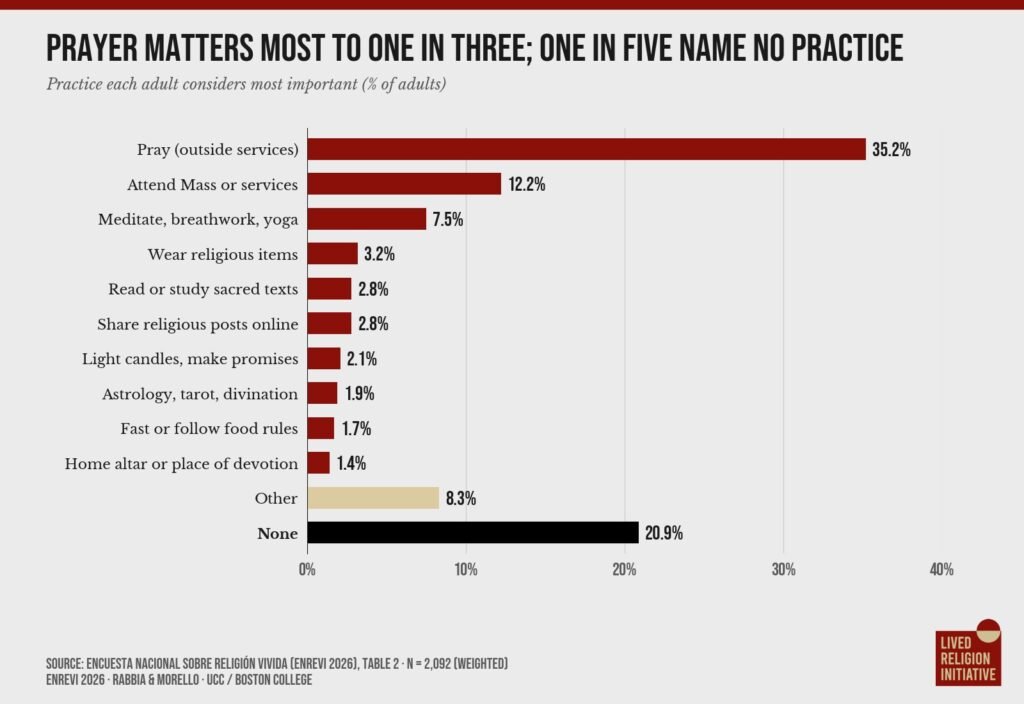
Doing something is not the same as valuing it. When asked which practice is the most important in their lives, 35.2% said prayer. Mass or services came a distant second at 12.2%, and it is still the main communal and institutional practice people value.
One in five (20.9%) said no practice is especially important. The authors read this as a weak, sporadic or diffuse bond with the sacred: when these people do something religious, it is mostly out of habit or curiosity.
The answers change with religious affiliation:
- Catholics and Evangelicals both put private prayer first (about 40%). In second place, Evangelicals name reading and studying sacred texts (15.4%) and Catholics name Mass (15.5%).
- The religiously unaffiliated: 45.5% say no practice is most important. In second place come meditation, breathwork or yoga (15.9%).
Screens, algorithms and the stars
Lived religion in Argentina also moves through screens and outside traditional boundaries:
- Social media: 52.2% shared religious images, messages or prayers online in the past year, and 27.5% do so weekly or daily.
- Religious media: 47.3% consumed religious content on TV, internet, radio or podcasts, and 28.9% do so weekly or daily.
- AI: 22.9%, more than one in five adults, asked an AI chatbot about religious or spiritual matters in the past year.
- Astrology and divination: 29.3% consulted a birth chart, tarot, horoscopes or other divination.
- Alternative therapies: 19.2% used reiki, feng shui, biodecoding or similar.
Popular devotion is also widespread. Half of adults (50.4%) lit candles, made promises or left offerings to saints or other spiritual figures, though only 2.1% call it their most important practice.
Believing, belonging and leaving
Belief is still widespread:
- 70% believe in God.
- 8.3% believe in a higher energy or order, but not in God.
- 76.9% believe in the existence of the soul.
Belonging, however, is shifting. Comparing the religion people were raised in with their religion today shows a significant migration from childhood Catholicism to no religious affiliation.
The unaffiliated grew from 5.8% to 19.3%, and Evangelicals grew from 11.3% to 14.3%. Catholicism is still the majority, but 17.8 points below the share raised in it.
Waiting for Pope Leo XIV
The survey was fielded weeks before Pope Leo XIV’s visit to Argentina. 16.5% of adults intend to go and see him, which is more than 5 million people aged 18 and over. Another 34% are still undecided and 49.5% do not plan to go.
- Who plans to go: 77% are Catholic and almost 11% are Evangelical. Intention is slightly higher among lower socioeconomic groups (18.4%).
- Politics: supporters of La Libertad Avanza and of left-wing parties are somewhat less inclined to go than supporters of Peronism, Kirchnerism and PRO.
Two of the Pope’s social positions have broad support:
| Statement | Agree | Disagree | Don’t know |
|---|---|---|---|
| Public oversight of AI to prevent disinformation and mass surveillance (encyclical Magnifica Humanitas, May 2026) | 75.2% | 11.3% | 13.5% |
| Water, food and healthcare should be kept out of financial speculation (apostolic exhortation, June 2026) | 77.4% | 13.6% | 9.0% |
Source: ENReVi 2026, Figures 6 and 7.
La Libertad Avanza supporters agree less than others with both statements, but still above 60%. According to the authors, the visit seems to draw an audience broader than “practicing Catholics”.
The rise of religiously non-affiliated
The authors draw four conclusions:
- Look at practices, and religion is everywhere. Fewer than 5% of Argentines did none of the practices surveyed. What is changing is the shape of that religiosity, which is more diverse and more personalized.
- High- and low-intensity religiosity coexist. For some people, daily life is full of religious and spiritual practices. For others, the practices they report are not especially meaningful. At least 20% “do” religion without much motivation, or out of habit.
- Religious practice is becoming private and individual. Solitary, intimate and domestic practices (praying alone, meditating, keeping a home altar) take priority over group and communal ones. This consolidates what some scholars call cuentapropismo religioso, or “religious self-employment”: people put together their own repertoire of practices without depending on an institution.
- The papal visit reaches beyond the pews. Leo XIV’s positions on AI and on basic goods as human rights enjoy majority support regardless of religion or party.
About the study
Authors: Hugo H. Rabbia (Universidad Católica de Córdoba / CONICET) and Gustavo Morello, SJ (Boston College).
Research team:
- Universidad Católica de Córdoba: Hugo H. Rabbia, Franco Olmos Rebellato, Iriana Sartor, Abigail Vannelli
- Boston College: Gustavo Morello, SJ
- Instituto de Investigaciones, Facultad de Ciencias Sociales, Pontificia Universidad Católica Argentina: Juan Martín López Fidanza, María Pilar García Bossio, Ana Lourdes Suárez
- Universidad Católica de Cuyo (San Juan): Maylin Martínez Muñoz
| Item | Detail |
|---|---|
| Participating institutions | Universidad Católica de Córdoba; Lived Religion Initiative, Boston College; Instituto de Investigaciones, Facultad de Ciencias Sociales, UCA |
| Funding | Knowledge Management Center of the Latin American and Caribbean Episcopal Council (CELAM) and the Lived Religion Initiative, Boston College |
| Population | Adults 18+ living in Argentina, all 24 jurisdictions |
| Sample | 2,414 observed cases, 2,092 weighted by region and age |
| Method | Online self-administered survey (84.5%, quota sampling by gender and age) and in-person household survey (15.5%, simple random sampling) |
| Questionnaire | 32 questions, about 20 minutes |
| Margin of error | ±2.0 points at 95% confidence |
| Fieldwork | August 27 to September 7, 2026, by Zuban Córdoba y Asociados |
Read the full report: Encuesta Nacional sobre Religión Vivida (ENReVi 2026), first report (in Spanish). See also Universidad Católica de Córdoba’s announcement and La Nación’s coverage.