Long before passport stamps and photographs, pilgrims needed a way to prove they had reached a place that mattered. Many of them chose the most permanent option available: they had the proof cut into their skin.
Blood, Ink & Soul is a four-part documentary series from the Lived Religion Initiative that follows that practice into the present. Filmed in Jerusalem, Italy, Spain and Mexico, it asks the question at the centre of our research: what do people actually do when they do religion?
Four cities, four traditions
In Jerusalem, Nizar Razzouk belongs to the twenty-eighth generation of the oldest tattooing family in the world. For more than seven hundred years the Razzouks have marked pilgrims — first in Egypt, where a Coptic cross on the wrist worked as a code: shake a hand, glimpse the cross, and the church doors opened to you. In the Old City they tattooed from designs hand-carved into olive wood, because stencils did not yet exist.
In Loreto, Italy, pilgrims to the Holy House were once tattooed in the square outside the basilica by shoemakers, masons and gravediggers — not one of them a professional artist. The city banned the practice in 1871 on sanitary grounds, and it survived in secret until it almost disappeared. In 2019 a local artist, Jona, brought it back, working with reproductions of the original brass stamps and a needle fixed to a hand-made tool, tapped into the skin exactly as it was done before.
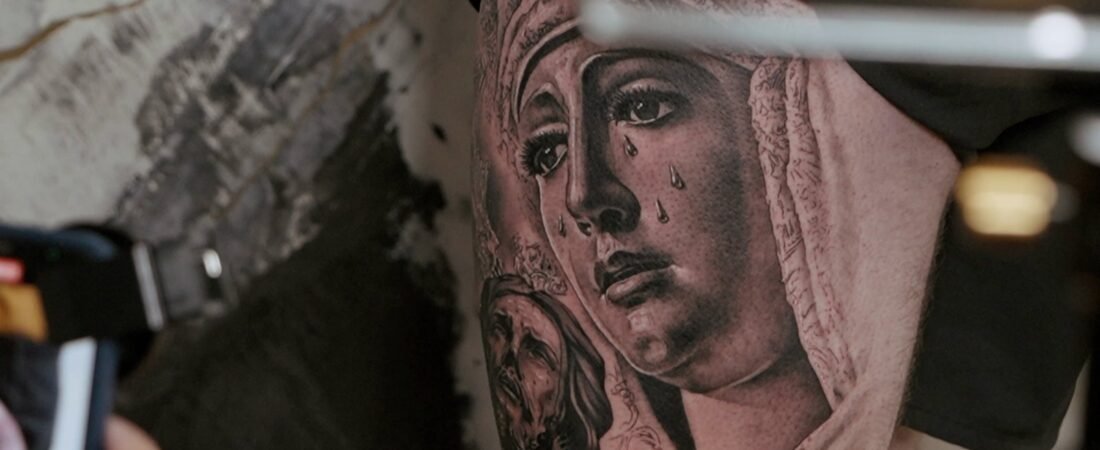
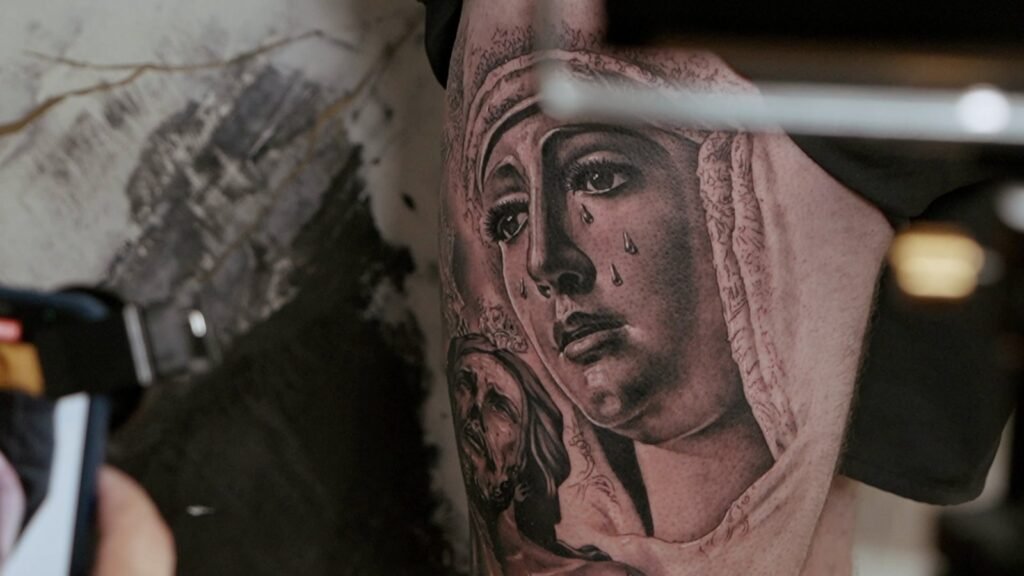
In Málaga, Daniel Fernández tattoos the images that Andalusian brotherhoods carry on their shoulders each Holy Week, working to the sound of processional marches and the incense of each cofradía. His clients rarely arrive with a design. They arrive with a story: this was my grandmother’s faith; my father carried this Christ his whole life.
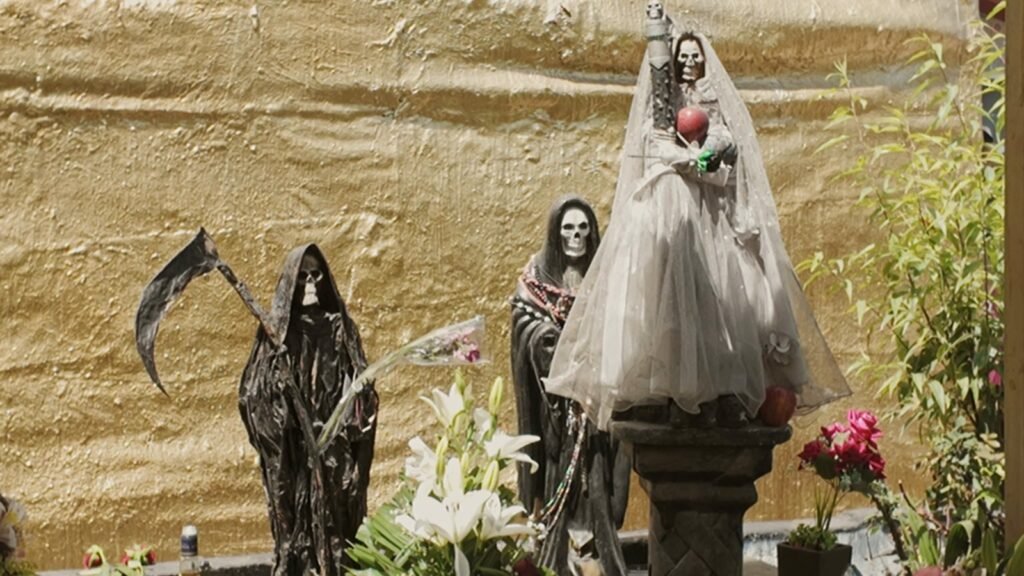
In Mexico City, Andrés tattoos devotees of la Santa Muerte, a cult that stepped into public view in 2001 and now gathers police officers and ex-prisoners, homemakers and people who find no room in any other congregation. Many come to settle a manda, a promise kept. Others come, he says, because ink is the only language they have left for what they are carrying.
What the skin remembers
Across four very different religious worlds, the same logic keeps surfacing. A tattoo proves you were there — and that you did not come back the same. It keeps the dead close. It turns a private devotion into something public, authorised by the believer alone, without waiting for permission from any institution.
People still believe. They have simply stopped asking institutions how.
That is exactly why these marks interest us. Our research across Latin American cities keeps finding the same pattern: religion has not receded, but it has moved. People believe as much as ever, and increasingly they assemble that belief themselves, mixing traditions, choosing what binds them and what does not. Skin turns out to be one of the clearest places to read it.
Watch the series
All four films are available with English subtitles at https://www.youtube.com/@LivedReligionInitiative